
-4.png)
Most people see writing as an art. I see it as architecture.
Not because writing lacks beauty or creativity, but because beauty and creativity crumble without structure. If you've worked with me—or if you've followed Trivium Writing—you know that writing is not only a form of expression but a strategic act of construction. What looks fluid on the page stands on solid structural ground.
After working with over 130 clients across industries, disciplines, and cultures, I've noticed one pattern: people don’t fail to write because they lack talent. They fail because they lack structure. Whether they’re writing research papers, blog posts, or nonfiction books, most writers get lost in a sea of ideas without a clear path forward. That’s where the Internal Architecture comes in.

At Trivium Writing, we developed the Architecture of Writing™ to solve this very problem. The Internal Architecture is one of its core pillars. It’s the underlying framework that makes your message resonate. Think of it as the logical structure beneath the surface—the bones holding your ideas in place.
If you’ve ever struggled to start writing, clarify your main argument, or organize information into paragraphs that flow, what you lacked wasn’t effort—it was a system. Structuring your writing effectively isn’t about learning new tricks. It’s about mastering timeless principles.
In this article, we’ll explore the core components of the Internal Architecture: eight essential elements that bring structure, clarity, and purpose to your writing. Whether you're creating a book, an article, or a persuasive essay, these elements will help you move from scattered thoughts to structured ideas with impact.
Table of Contents
- The Eight Steps of Structuring Your Writing
- Main Points and Logical Structure
- The Role of Planning and Outlining in Structuring Your Writing
Let's begin where all great writing starts—not with words, but with structure.
The Eight Steps of Structuring Your Writing
To ensure your writing is well-structured and effective, use these eight essential components:
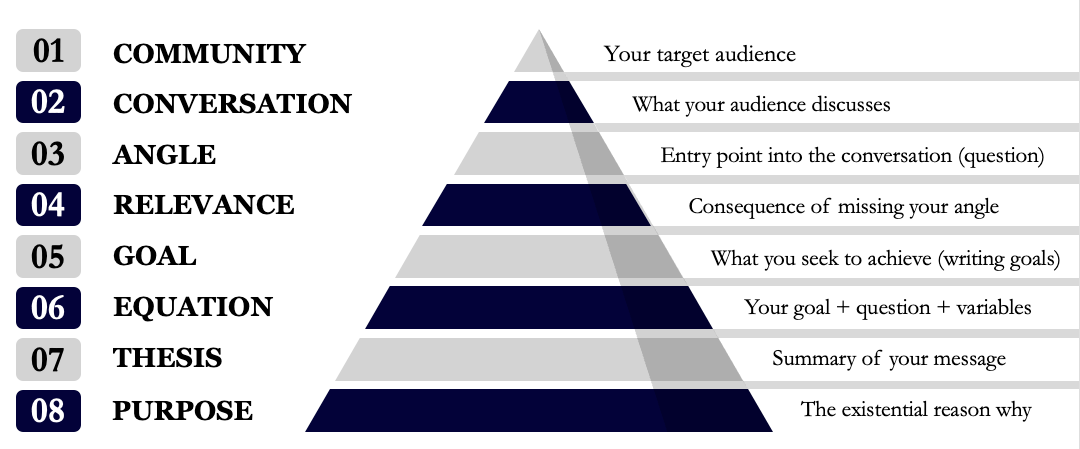
By organizing your arguments and breaking up your writing into manageable sections, you can help readers digest the key points within the text.
1. Community
Every piece of writing is a conversation—even if your reader never replies.
Before you write a single sentence, you must know who you’re writing for. Not in vague terms like “professionals” or “the public,” but with precision. Who are they? What do they care about? What language do they respond to? This isn’t just a marketing exercise—it’s structural.

Audience shapes everything: the voice you use, the stories you tell, the evidence you present. It’s the first component of your Internal Architecture—what I call Community. Without clarity on your community, your writing floats. With it, your writing anchors.
When I work with someone on a book or thought leadership piece, the conversation always begins with the audience. If you’re writing for peers, you’ll rely on shared knowledge and go deeper into technical nuance. If you’re writing for a general public, you’ll unpack concepts more and use stories as bridges.
This step affects every layer of your writing structure. Your main argument is built for someone. Your main points must follow a logical order they can understand. Even your sentence structure must serve their reading rhythm.
Here’s how to identify your audience with more depth:
-
Research deeply. Look beyond demographics. Study what your audience reads, watches, and discusses. Social media insights, comment sections, and interviews are more useful than generic avatars.
-
Create personas with precision. Build profiles not just around age or profession, but around values, beliefs, and blind spots. A strong persona reflects the reader’s inner world, not just their LinkedIn title.
-
Listen. Then listen more. Interact with your audience through real conversations. Whether it’s in your inbox, at events, or online forums, these interactions reveal the emotional and intellectual language your writing must speak.
Once you understand your audience, you can design a writing structure that meets them where they are—and leads them where they need to go.
2. Conversation
Writing doesn’t exist in a vacuum. Every idea you share steps into a larger conversation.

If you want your writing to stick—to be read, remembered, and acted upon—you must understand what your audience is already discussing. This is the second pillar of the Internal Architecture: Conversation. It’s where strategy meets empathy.
When someone lands on your article, essay, or book, they’re not starting from zero. They come with context: beliefs, frustrations, questions, and assumptions. If your writing ignores that context, it feels disconnected. If it reflects that context, it feels essential.
I’ve seen time and time again how recognizing the narrative structure already playing out in your reader’s mind changes everything. It sharpens your angle, clarifies your examples, and guides your choice of main points. This alignment elevates your credibility—and your impact.
Here’s how to engage with the conversation thoughtfully:
-
Identify current tensions. What’s being debated? What’s misunderstood? What’s missing? These gaps are opportunities to position your work meaningfully.
-
Analyze the language. Notice how your audience frames their problems. Use similar terms to show alignment, but shift the perspective to lead them somewhere new.
-
Be specific about your point of entry. General observations get lost. Specific insights get traction. Ground your writing in a real-world moment, trend, or question your audience cares about now.
Whether you’re crafting research papers, articles, or a nonfiction book, situating your writing within an existing dialogue increases its relevance. It also lays the foundation for a strong angle, the next element in your Internal Architecture.
3. Angle
Every audience is busy. Every conversation is crowded. To be heard, your writing needs a clear angle—a distinct point of entry into the dialogue.
The Angle is the third element of the Internal Architecture. It’s how you orient your message so it captures attention and signals value from the first line. Without an angle, your writing blends into the noise. With one, it pierces through.
Finding your angle isn’t about being clever. It’s about being intentional. It’s how you shape the main idea to connect with the audience’s needs while staying true to your voice and purpose.
I often guide clients through this by asking, “What question are you answering—or challenging?” A strong angle emerges from tension. It reframes the conversation with clarity and courage. It’s the hinge between knowing your audience and leading them somewhere new.
To sharpen your angle:
-
Ask a better question. Forget generic prompts. Ask provocative, high-resolution questions that lead to depth. The sharper the question, the sharper the writing.
-
Make it personal and structural. Your angle should align with your overall structure. It sets the stage for your main argument, dictates your paragraph structure, and determines how your body paragraphs unfold.
-
Anchor it in insight. Your angle isn’t just what you think—it’s what you’ve seen. Use lived experience, expert knowledge, or fresh analysis to frame your point of view with substance.
Whether you're outlining a blog post or drafting an essay, your angle guides the writing. It tells the reader, “This is why it matters, and this is why it’s different.” Without it, writing lacks spine. With it, writing gains power.
4. Relevance
A compelling angle captures attention. But relevance keeps it.
No matter how strong your insight or how clean your sentence structure, if your audience doesn’t understand why your message matters now, they won’t engage. Relevance is the fourth pillar of the Internal Architecture. It answers the unspoken reader question: “So what?”
This is where many smart professionals miss the mark. They assume the importance of their idea is obvious. It’s not. Your job as a writer is to surface the consequences of neglect. What happens if your audience ignores this topic? What do they risk missing, losing, or misunderstanding?
I call this creating stakes in your writing structure. When your reader sees the cost of inaction, the value of your message becomes tangible. This isn’t manipulation—it’s clarity.
To build relevance into your structure:
-
Draw a line from idea to outcome. Connect your main point to a result your reader cares about. If they don’t act on what you’re saying, what deteriorates or remains unresolved?
-
Speak to their context. Refer to current events, cultural shifts, or industry patterns to position your writing within their world—not yours.
-
Don’t assume. Articulate. Just because you see the urgency doesn’t mean they do. Spell it out. Help them understand the implications clearly.
Relevance transforms your writing from interesting to indispensable. It pushes the reader to stay with you through the main body of your argument—where the deeper work begins.
5. Goal
Relevance earns attention. But goal gives direction.
If you don’t know exactly what your writing is meant to achieve, neither will your reader. That’s why Goal is the fifth element of the Internal Architecture. It’s not just a vague intention—it’s a deliberate outcome your writing structure is designed to support.
When I ask clients what they want their piece to do, they often say, “I just want to share my ideas.” That’s not enough. Sharing is passive. Writing—when done right—is purposeful. You may want to inform, persuade, inspire, or provoke. But you must choose. Otherwise, the main argument will lack spine and your body paragraphs will wander.
Here’s how to clarify your goal:
-
Name the transformation. What should your reader know, believe, or feel differently after reading? Define the shift you want to produce.
-
Match form to function. A persuasive article has a different structure than an explanatory one. Choose a writing structure that aligns with your intention—whether it’s argumentative, chronological, or narrative.
-
Stay anchored. As you write, measure every section against your goal. If a paragraph doesn’t move the needle, it doesn’t belong in the main body.

Your goal acts as your compass. It shapes your main points, determines your logical structure, and helps you avoid unnecessary detours. Without a clear goal, even well-written sentences can lead nowhere.
6. Equation
Once you know your audience, your angle, and your goal, the next step is to align them. That’s what the Equation does. It’s the sixth element of the Internal Architecture, and it’s where clarity meets structure.
Think of the Equation as the blueprint of your message. It weaves together your goal, your main question, and the variables—audience context, evidence, subpoints—that bring your idea to life. Without this step, writing becomes linear output instead of strategic assembly.
This isn’t about writing math. It’s about designing your structure with intention. I’ve coached clients through this by mapping the writing before they type a word. We don’t just start writing—we structure first.
To build your Equation:
-
Write the core sentence. Reduce your message to a single formula: “I am writing for [audience] to help them understand [question] so they can [outcome].” This sentence becomes the nucleus of your writing plan.
-
List the components. Break down your answer into main points that support your overall argument. These will form your body paragraphs and give your piece a solid essay structure.
-
Choose your format wisely. Will your structure follow a chronological structure? A linear structure? An argumentative structure? Select a shape that reinforces your message.
The Equation helps you organize information before drafting. It reveals what needs to be said, in what order, and how deeply. It also prevents overwhelm—because once the structure acts as a guide, the writing becomes execution, not guessing.
7. Thesis
If your Equation is the blueprint, your Thesis is the foundation.
The Thesis is the seventh element of the Internal Architecture. It’s the sentence that holds your entire piece together. It defines the main argument and creates unity across your body paragraphs. Without it, even a beautifully written piece loses coherence. With it, every sentence has purpose.
I’ve worked with authors, consultants, academics—people with powerful insights—but when they skip this step, their writing collapses under its own weight. A clear thesis focuses the mind and centers the structure.
This doesn’t mean writing a generic statement or a filler intro. A thesis should do real work.
Here’s how to craft one that delivers:
-
Make it specific and arguable. “Leadership matters” is not a thesis. “Leaders build trust faster when they communicate in writing” is.
-
Use it as a structural filter. Every main point in your main body should support your thesis. If it doesn’t connect, cut it.
-
Place it early. Whether it’s an academic essay or a blog post, your reader should grasp your main idea within the first few paragraphs. Structure the introduction around it.
A strong thesis doesn’t just summarize your writing—it anchors it. It gives the reader a reason to follow your logical structure and helps them track your overall argument from start to finish.
8. Purpose
Structure gives shape to writing. But Purpose gives it soul.
This is the eighth and final element of the Internal Architecture. It’s not about your professional goal or a tidy call to action—it’s about the deeper reason this writing needs to exist. Purpose is what keeps you grounded when the work gets heavy, and what makes your words resonate beyond information.
When I ask clients, “Why are you writing this?” I’m not looking for a project brief. I’m looking for conviction. Because that’s what fuels consistent, focused, high-impact writing. When you know why your message matters—not just to your audience, but to you—your structure becomes more than efficient. It becomes meaningful.
To uncover your purpose:
-
Look beyond the product. Don’t stop at “I want to finish a book.” Ask: Why this book? Why now? What shift do you want to create in the world, even in a small way?
-
Make it personal. Whether you’re writing an article, essay, or business memoir, your purpose connects the content to your character. That connection builds trust.
-
Let it guide your tone and structure. Purpose influences everything—from your sentence structure to your paragraphs, from your main idea to your conclusion. It holds the emotional thread.
When purpose is clear, structure follows with more clarity and discipline. And when structure aligns with purpose, readers feel it. They don’t just process the information—they engage with it.
Now that you’ve seen all eight structural elements—Community, Conversation, Angle, Relevance, Goal, Equation, Thesis, and Purpose—you can begin to structure your writing from the inside out. But structure doesn’t end here.
Main Points and Logical Structure
Once your Internal Architecture is set, your next job is to build the body—what most people think of as “the content.” But without a clear logical structure, the content doesn’t land.
The main body of your writing exists to deliver on the thesis—and to do that, it must rest on solid main points. These aren’t just random insights or clever thoughts. They are structural pillars that support the overall argument.
In coaching sessions, I often help clients turn streams of scattered ideas into sequenced paragraphs with one job each: move the reader forward. That’s how you create writing that isn’t just read—but followed, absorbed, and acted upon.
Here’s how to shape your main points:
-
Assign one idea per section. Each body paragraph should carry one main point. If there’s more than one idea fighting for attention, split them up.
-
Sequence with intention. Whether you’re using a chronological structure, linear structure, or argumentative structure, make sure each point builds logically from the one before it. Disjointed writing is rarely about bad sentences—it’s about broken sequence.
-
Support with evidence. A main point without proof is just a claim. Use examples, case studies, research, or personal experience to ground each point and make it real.
Main points are not filler. They are core components of your structure. Treat them as such. Each one should be traceable back to the thesis—and each one should prepare the ground for the next.
Paragraph Structure
If main points form the skeleton of your writing, paragraphs are the muscle. This is where your ideas take shape, line by line, with structure the reader can follow without friction.
Paragraphs aren’t just visual breaks—they’re cognitive ones. Each paragraph delivers one clear idea, structured so the reader can grasp it without rereading. In coaching sessions, I often say: if the paragraph loses focus, the reader loses interest.
That’s why Paragraph Structure is non-negotiable. It gives your writing pace, clarity, and control.
Here’s the structure I recommend and teach:
-
Topic sentence first. Open with a sentence that clearly states the main idea of the paragraph. Don’t bury it. The reader should know immediately what to expect.
-
Support with evidence or explanation. After the topic sentence, provide detail, examples, or reasoning. This is where the paragraph earns its keep.
-
Conclude or transition. Wrap the paragraph with a sentence that reinforces the idea or prepares the reader for what’s next. Transitions build momentum.
A well-structured paragraph is a self-contained unit. It has a beginning, a middle, and an end—just like a miniature essay. In fact, most three body paragraphs in an essay follow this exact format. Master this, and you won’t just write better—you’ll think better.
Sentence Structure
Strong paragraphs depend on strong sentences. Weak sentence structure causes confusion, even when the idea is sound. When your sentences are clear, your thinking becomes accessible. That’s the essence of effective writing.
Most people overcomplicate sentences. They confuse complexity with depth. But in my experience—coaching entrepreneurs, educators, and experts alike—what readers respond to is clarity, rhythm, and intention. Sentence structure is where that begins.
Here’s how to sharpen your sentence-level writing:
-
Use sentence variety with purpose. Mix simple, compound, and complex sentences. Short sentences add punch. Longer ones allow nuance. But all should serve the main idea.
-
Avoid bloat. Cut needless modifiers and filler. Don’t say, “There are many reasons why writing can be difficult.” Say, “Writing is difficult because…” The clearest sentence always wins.
-
Use syntax to emphasize meaning. Put the most important words at the end or beginning of the sentence. Readers remember what you emphasize structurally.
Clear sentence structure reinforces your logical structure. It also strengthens your authority. When your writing flows line by line, readers stay with you—not because they’re trying, but because it’s effortless.
The Role of Planning and Outlining in Structuring Your Writing
Every building begins with a blueprint. Writing is no different.

Planning and outlining are how you move from idea to structure. They give shape to your main points, order to your argument, and clarity to the overall piece. Most people skip this step and suffer for it—starting with scattered thoughts and hoping structure will appear along the way. It rarely does.
A plan is not restrictive. It’s liberating. Once your ideas are organized, writing becomes execution, not exploration. This is where we turn the Internal Architecture into a concrete writing plan.
Here’s how to plan with structure in mind:
-
Start with your thesis. Everything hangs on this. It defines your main idea, anchors your argument, and shapes the content of your body paragraphs.
-
Identify 3–5 main points. These are the structural beams of your writing. Arrange them in a logical order—progressive, chronological, or argumentative depending on your goal.
-
Gather support before writing. List examples, stories, stats, or insights for each point. This prevents gaps and keeps you from stopping mid-draft to “find a quote.”
And here’s how to outline for clarity:
-
Introduction: Provide background information, state the problem or context, then present your thesis.
-
Body paragraphs: Each one should begin with a topic sentence, develop the main point with support, and close with a transition.
-
Conclusion: Summarize key insights, reaffirm the thesis, and leave the reader with direction or reflection.
Outlining is not optional—it’s the infrastructure of highly effective writing. It saves time, strengthens coherence, and minimizes rewriting. In short, it lets you write with purpose from the very first sentence.
Conclusion
Writing isn’t just about saying something—it’s about building something. That’s what the Internal Architecture gives you: a foundation to structure your message with intention, clarity, and impact.
When you approach writing like a builder, everything changes. Ideas become organized. Sentences carry weight. Paragraphs move readers. Whether you're working on research papers, articles, essays, or a nonfiction book, the Internal Architecture makes writing feel less like guesswork and more like craftsmanship.
If you want your writing to create real change—to educate, persuade, or lead—then structure isn't optional. It’s essential.
Whether you’re starting a book, refining a thought leadership piece, or looking to bring more clarity to your content, I can help you apply this structure to your unique project. You don’t need to be a professional writer—you just need the right framework and a bit of guidance.
Let’s build something powerful together. Book a free consultation and let’s talk about your message.

Article by Leandre Larouche
Leandre Larouche is a writer, coach, and the founder of Trivium Writing.

-2.png?width=352&name=SERVICES%20IMAGES%20(10)-2.png)
.png?width=352&name=SERVICES%20IMAGES%20(14).png)
-Feb-26-2026-07-55-20-2076-AM.png?width=352&name=SERVICES%20IMAGES%20(2)-Feb-26-2026-07-55-20-2076-AM.png)