
-1.png)
When most people think of writing, they think of grammar, essays, or maybe creative stories. But writing, at its core, is about communication. And communication only works when it's structured with purpose and clarity.
At Trivium Writing, we've worked with over 130 clients across 10+ countries—entrepreneurs, professors, C-suite leaders, and aspiring authors—who all came to us with something to say but struggled to express it. The problem wasn’t talent. It was a lack of understanding of how different types of writing serve different goals.
In truth, there are four main types of writing styles: expository, descriptive, persuasive, and narrative. Each serves a distinct function in helping writers meet their communication objectives. Understanding these four types is foundational to mastering writing skills, and it’s where we begin when coaching clients through our Architecture of Writing methodology.
Let’s break them down from the lens of a writing consultant who’s seen firsthand how clarity changes lives.
Table of Contents
- Understanding the Four Main Types of Writing
- Descriptive Writing: Painting Vivid Pictures
- Explanatory Writing: Presenting Facts Logically
- Persuasive Writing: Influencing Opinions
- Narrative Writing: Telling a Story
- Choosing the Right Writing Style for Your Purpose
- Frequently Asked Questions
- Final Thoughts
Understanding the Four Main Types of Writing
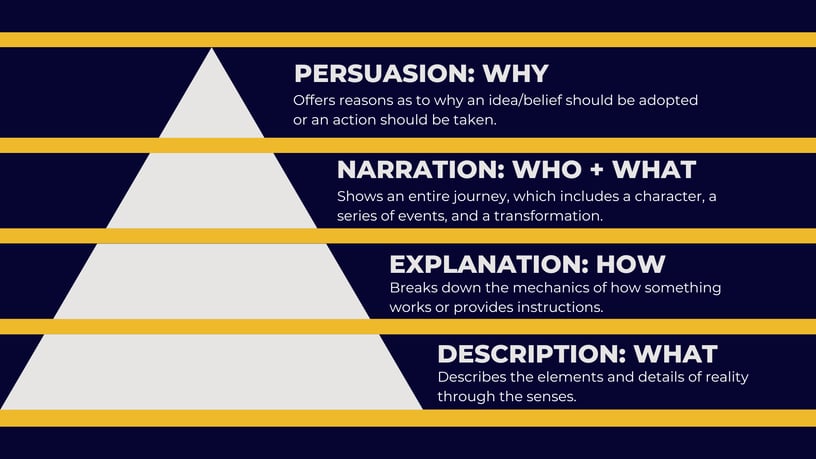
Different types of writing produce different results. If you're pitching an idea, you need persuasive writing. If you're documenting a process for your team, you rely on explanatory writing. If you’re trying to move your audience emotionally, you blend narrative and descriptive writing.
Too often, people default to one writing style because it's what they know. But that’s like trying to build an entire house with just a hammer. Through our work at Trivium Writing, we teach our clients to identify the right type of writing for their purpose using our Internal Architecture—a framework that clarifies purpose, question, goal, and relevance.
Here’s what this means in practice:
- Descriptive writing helps readers visualize.
-
Explanatory writing helps readers understand.
- Narrative writing helps readers feel.
-
Persuasive writing helps readers believe.
And when you combine them skillfully—what we call blended architecture—you don’t just communicate. You resonate.
Note: The 4 writing types are sequenced in order of strength. While they are all important and should all be used, they do not hold the same same weight. Descriptive writing
Inside the Architecture of Writing
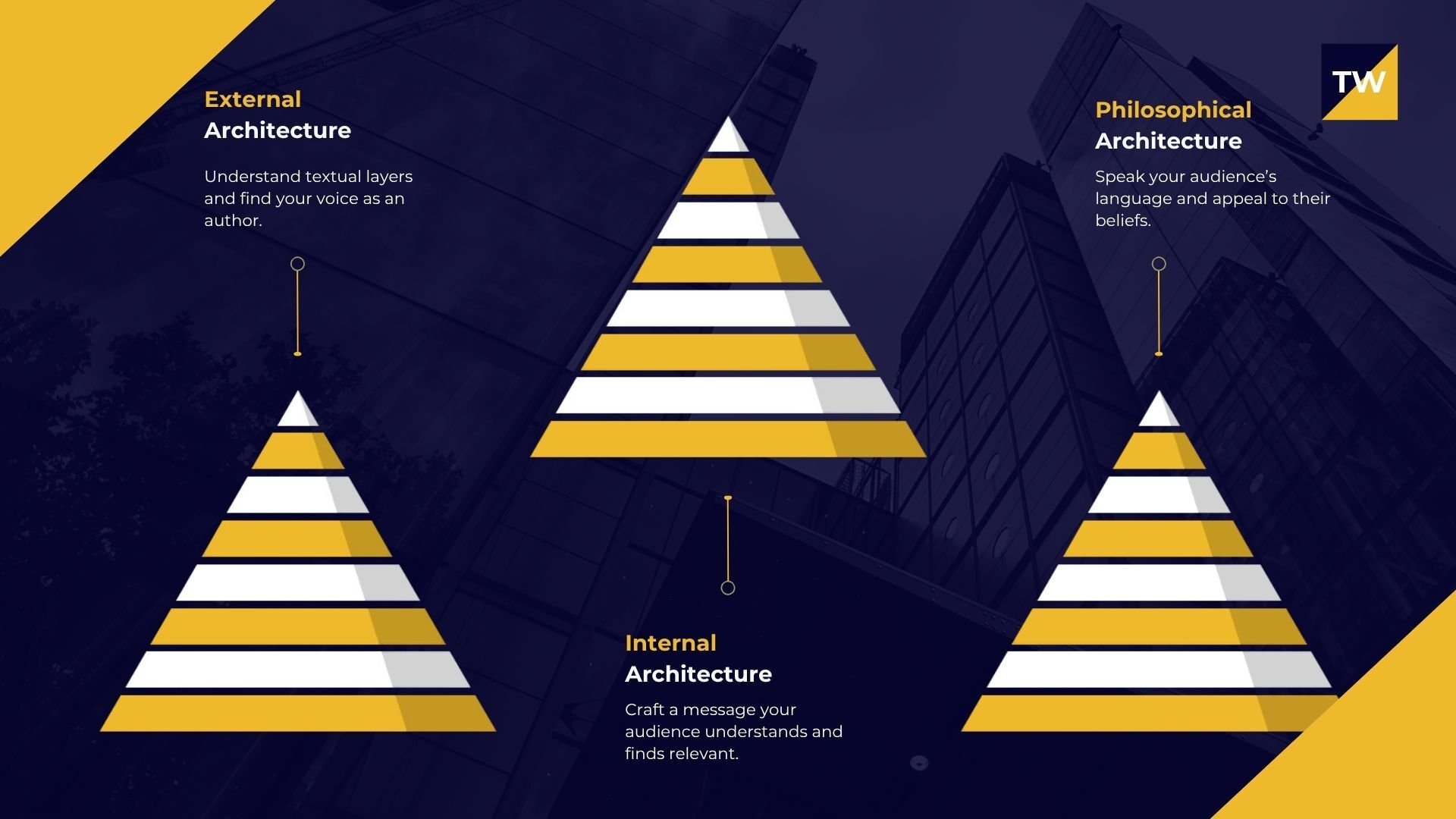
At Trivium, we use three key frameworks to elevate communication:
-
Internal Architecture: clarifies what you’re saying and why.
-
External Architecture: shapes how your writing sounds and looks to your audience.
-
Philosophical Architecture: aligns your message with the deeper beliefs of your readers.
For example, when a tech founder comes to us to write a book or keynote, we guide them through identifying their main types of writing styles. We help them move beyond scientific writing filled with jargon and toward narrative writing that tells a story—because the human brain is wired for narrative.
Once you know which style fits your goal, the writing becomes systematic.
Real-World Application
Over the years, I’ve coached people who had the knowledge but not the language. They were experts in law, finance, tech, or healthcare. Some had never written beyond cover letters or academic writing. But once they understood the four core styles, everything changed.
A client writing a policy proposal used explanatory writing to structure her ideas, then infused it with persuasive writing to make it compelling. Another client writing a memoir leaned into narrative writing but learned to use descriptive writing to bring scenes to life using the five senses.
Every time, the transformation wasn’t just in the writing. It was in the writer.
Descriptive Writing: Painting Vivid Pictures

Most people don’t struggle to write; they struggle to make their writing felt. They explain a scene, describe an event, or introduce a character, but their words fall flat. That’s where descriptive writing changes the game.
Descriptive writing is the type of writing that lets your reader experience rather than merely understand. It immerses them through the five senses—sight, sound, smell, touch, and taste. It’s not just about relaying facts; it’s about evoking images, textures, and moods so powerfully that your audience feels as if they’re there.
We see descriptive writing in diary writing, poetry, short stories, and even marketing copy. A strong brand doesn’t just explain its product; it paints a vivid picture of the lifestyle, emotion, or transformation associated with it.
At Trivium Writing, we help clients leverage this writing style when they need to move their audience emotionally. It’s an essential tool in storytelling, memoir, and persuasive content. And it’s often the difference between a forgettable piece and one that leaves a lasting impression.
Where and When to Use Descriptive Writing
Descriptive writing is most powerful when you want to:
-
Capture a mood or environment
-
Highlight emotional states
-
Build an atmosphere for a story or speech
-
Add color and depth to otherwise dry exposition
One of our clients, a mindfulness coach, used descriptive language to transform her content. Rather than saying “Take a deep breath,” she wrote: “Breathe in slowly, as if sipping calm through a straw.” One sentence, one image—more impact.
Another example: a leadership consultant writing about burnout. Instead of “Burnout feels bad,” we rewrote it as: “Burnout creeps in like fog at dusk—quiet, dense, and suffocating.” That’s the difference detail makes.
Techniques to Master Descriptive Writing
There’s a misconception that descriptive writing requires poetic flair. Not true. What it requires is precision and sensory awareness.
Here are a few techniques we teach clients inside our coaching programs:
-
Similes and metaphors: Comparing one object or experience to another deepens meaning.
Example: Her voice cracked like old vinyl. -
Personification: Giving human traits to non-human elements creates intimacy.
Example: The wind whispered warnings between the trees. -
Vivid nouns and strong verbs: Choose words that do heavy lifting. Instead of “walked slowly,” try “dragged” or “lurched.”
-
Avoid weak modifiers: Cut words like “very,” “really,” or “nice.” Say “icy” instead of “very cold.”
(We actively discourage these in our client work for a reason.) -
Focus on one dominant sense per moment: Trying to do all five senses at once overwhelms readers. Lead with the strongest.
Structure Still Matters
Even the most artistic writing styles benefit from structure. Through our Architecture of Writing framework, we teach clients how to incorporate descriptive writing into essays, business books, and speeches without losing focus.
Use descriptive paragraphs strategically. They shine in introductions, turning points, and moments of reflection. And always tether them to the author’s point—description without purpose is indulgence.
One Client’s Transformation
A life coach came to us to write her first book. Her original drafts felt informative but flat. So we reworked key sections using descriptive writing, especially where she shared client stories.
One scene, in particular, stood out: "He sat across from me, shoulders clenched like drawn bows, eyes darting between the floor and the door. His silence screamed louder than his words ever could."
That paragraph captured more than data ever could. It created empathy.
That’s the power of descriptive writing. Not just to inform but to move.
Explanatory Writing: Presenting Facts Logically

When someone asks me, “What’s the most overlooked writing style in business?”, my answer is always the same: explanatory writing.
Why? Because people think writing should sound impressive. They chase elegance and overlook clarity. However, if you can't explain your idea in simple terms, your reader can’t act on it. And in business or thought leadership, inaction is a cost.
Explanatory writing is the art of presenting facts, concepts, and processes in a clear, logical order. It’s the go-to type of writing when you want your audience to understand—not feel, not be persuaded, just comprehend. You’ll find this style in textbooks, how-to articles, scientific writing, news stories, and academic writing.
At Trivium Writing, we train clients to write expository content using a thesis-first approach. The structure we recommend mirrors the Architecture of Writing: start with a strong point, build support with evidence, and layer in clear transitions so the reader never feels lost.
When to Use Explanatory Writing
If you’re explaining a concept, teaching a method, or documenting a process, you’re in expository territory. This is where writing skills meet logic.
A few places explanatory writing thrives:
-
Internal business documentation
-
Standard operating procedures (SOPs)
-
Educational blog posts
-
Instructional manuals
-
Research papers and policy briefs
For example, a tech founder explaining how their algorithm works should use explanatory writing. So should a wellness coach outlining their 5-step client process.
I once worked with a CEO drafting a shareholder letter. At first, he tried using flowery prose to sound "inspiring." We stripped it back to just the facts and used a clear chronological order. The result? His board actually read the entire thing and responded with thoughtful questions instead of confusion.
How to Write Explanatory Content Effectively
Most people overcomplicate their writing. The secret to strong expository prose is discipline—not style.
Here’s a process I recommend:
-
Start with your thesis: What is the one thing your reader should understand by the end?
-
Break it into questions: What does the reader need answered to believe or accept your thesis?
-
Use structured paragraphs: Begin each paragraph with a topic sentence, then use examples, details, and data to support it.
-
Remove personal opinions: Explanatory writing is about facts, not feelings.
-
Use transitions wisely: Words like first, therefore, next, and as a result guide the reader through your reasoning.
This is where our Foundational Questions and Writing Equation frameworks support clients most. We help them translate complexity into clarity by mapping their ideas before a single word hits the page.
One Client’s Shift to Explanatory Clarity
Another client, a brilliant academic, was struggling to turn her research into a public-facing article. Her first draft read like a thesis: dense, abstract, inaccessible.
Together, we identified her author's point, broke down her data into digestible chunks, and structured her writing around questions her audience was already asking.
The result was a crisp, compelling piece that positioned her as both credible and clear.
That’s the power of explanatory writing done right.
Persuasive Writing: Influencing Opinions

Every day, you’re persuading someone whether you realize it or not. You’re selling a vision to your team, pitching a new client, or even convincing yourself to write that book you’ve been postponing.
That’s why mastering persuasive writing is indispensable. This type of writing allows you to influence opinions and guide readers toward a specific belief or action. You’re not just presenting facts (as in explanatory writing) or creating imagery (as in descriptive writing)—you’re shaping perspectives.
At Trivium Writing, I work with founders, authors, and executives who often struggle to articulate what they believe and why it matters. They have a strong voice in conversation, but their written arguments fall apart because they skip structure, logic, and audience alignment.
That’s where persuasive writing fills the gap.
When to Use Persuasive Writing
This writing style thrives wherever you want to prompt change—whether in thinking, behavior, or action. You’ll find it in:
-
Editorial pieces
-
Marketing materials
-
Cover letters
-
Thought leadership articles
-
Business proposals
For example, when a wellness entrepreneur wants to position breathwork as essential to executive health, she’s not just informing (expository) or describing (descriptive). She’s trying to convince skeptical readers that breathwork belongs in boardrooms.
Persuasive writing isn’t just about being right. It’s about being relevant. That means understanding your audience—their values, doubts, and language—and then meeting them where they are.
How to Craft a Persuasive Argument
Through our Philosophical Architecture framework, we teach clients to align their message with the reader’s beliefs, then challenge or reinforce them through structure.
Here's a persuasive strategy we’ve used across dozens of successful projects:
-
Lead with a hook: Ask a rhetorical question or make a bold claim.
Example: “What if your best ideas die because your writing doesn’t do them justice?” -
State your thesis clearly: Tell your reader what you want them to believe or do.
Example: “Every founder should write a book before scaling.” -
Use facts and logic: Support your thesis with evidence, examples, and statistics.
-
Layer in emotional appeal: Evoke empathy, urgency, or identity alignment.
Example: “People don’t buy what you do. They buy what you believe.” -
Preempt objections: Acknowledge your reader’s resistance. Show that you’ve thought it through.
-
End with a call to action: Guide them to the next step—download, share, buy, reflect.
Real-World Impact of Persuasive Writing
A client once approached us wanting to advocate for major urban policy changes in his city. He had passion, data, and vision...but no structure.
Together, we rewrote his article using our Writing Equation framework. We started with the reader’s worldview, reframed the issue using logical order, and layered in personal stories of affected residents.
The piece didn’t just inform; it stirred action. His op-ed got picked up by a major publication. City officials called him in for a meeting. That’s the power of writing that convinces.
Common Mistakes in Persuasive Writing
Many writers bury their main point. Others rely too heavily on emotion and forget to provide evidence. Some ignore their audience’s worldview entirely. And some sound defensive instead of assertive.
Persuasive writing succeeds when it’s confident, clear, and structured. At Trivium Writing, we don’t just help clients write better. We help them think more strategically about what they want others to believe—and how to get them there.
Narrative Writing: Telling a Story

When people tell me they want to write a book, they usually mean they want to tell a story. That’s the power of narrative writing; it speaks to something primal in all of us. Stories are how we make sense of the world, how we connect, how we remember.
Narrative writing tells a story, whether it’s based on real-life events or completely fictional. It follows a structure—a beginning, a middle, and an end—often tied together by characters, conflict, and a clear point. The goal is not just to entertain, but to carry the reader through an emotional or intellectual transformation.
In my work as a writing coach, I’ve helped clients transform life experience into meaningful short stories, memoirs, or professional anecdotes. The best narrative writing doesn’t just describe events—it gives those events weight. It shows change. It reveals truth.
When to Use Narrative Writing
Narrative writing appears in more places than people think. Beyond novels, short stories, and poetry, you’ll find narrative elements in:
-
Memoirs and autobiographies
-
Brand storytelling and case studies
-
Speeches and TED talks
-
Website about pages
-
Human interest articles
-
Leadership and business books
At Trivium, we often integrate narrative writing with other writing styles. For example, a founder’s letter might begin with a narrative anecdote, shift into explanatory explanation, and finish with a persuasive call to action. This blended style, when done well, captures both hearts and minds.
Essential Elements of Narrative Writing
Effective narrative writing relies on several core elements. When we coach clients on how to use narrative style, we guide them through the following:
-
Characters: Every strong narrative centers on people. Even in nonfiction, the protagonist—whether it’s you or someone else—needs distinct traits, motivations, and desires.
-
Setting: The environment isn’t just background. It frames the mood and stakes. Describe it with specificity to help readers see, hear, and feel the world of your story.
-
Conflict: Without tension, there’s no momentum. Whether it’s internal (a moral dilemma) or external (a business failure), conflict is what drives the transformation.
-
Structure: Most narratives follow a chronological order: introduction, rising action, climax, and resolution. This structure helps the reader track progress and feel payoff.
-
Point of View: Decide whether you’ll write in the first person or third person. Each creates a different relationship with the reader.
-
Theme or Lesson: What should the reader take away from this story? In narrative writing, the implicit message is just as important as the plot.
How to Write Compelling Narratives
We teach clients to enter stories in media res—in the middle of the action. This grabs attention immediately and avoids excessive backstory. You can always reveal context through dialogue, internal monologue, or reflection.
Avoid “telling” and focus on “showing.” For instance, don’t write “He was angry.” Write: “His jaw clenched. He threw the pen across the room.” Let your descriptions reveal emotion.
Also, avoid generic phrasing. Replace “things happened” with the specific events that shaped the narrative. Replace “stuff changed” with the exact decisions, failures, or insights that transformed the character’s path.
When used well, narrative writing not only captivates—it builds credibility. People don’t just want to know what you know; they want to know what you’ve lived.
A Client Story Worth Sharing
One of our clients, a financial executive, wanted to write a book but feared his story lacked emotional pull. He thought his journey was too technical, too dry.
Through our Foundational Questions and Specific and Detailed Questions process, we uncovered powerful personal moments—his fear of failure, his early mistakes, his silent mentor who changed everything.
The result? A narrative that framed his technical advice in real human experience. Readers didn’t just learn—they related.
That’s what narrative writing does. It builds bridges between you and your audience.
Choosing the Right Writing Style for Your Purpose

Most writers struggle not because they lack talent—but because they choose the wrong writing style for the job. They try to be poetic in a report or overly logical in a personal story. That mismatch creates confusion, weakens the message, and dilutes the impact.
Every writing project needs a strategy. At Trivium Writing, we help clients begin with clarity: What’s your goal? Who’s your audience? What do you want the reader to do or feel by the end?
Once you know your purpose, choosing the right type of writing becomes a matter of alignment. You’re not just writing—you’re designing communication that achieves a result.
How to Select the Best Style for Your Message
Let’s map the four types of writing to specific goals.
Use explanatory writing when your priority is clarity. If you’re explaining how a system works, breaking down research, or writing how-to articles, this style keeps your message logical, structured, and factual. It’s ideal for scientific writing, academic writing, white papers, and internal documentation.
Use descriptive writing when your goal is immersion. If you want your reader to visualize a scene or feel a moment through the five senses, use this style. It works well in diary writing, travel blogs, personal essays, and portions of memoirs or fiction.
Use persuasive writing when you need to convince. Whether you’re writing cover letters, marketing copy, or editorial pieces, persuasive writing helps readers adopt your opinion or take action. This is the go-to style for branding, fundraising, and thought leadership.
Use narrative writing when you want to build connection. This style is effective for case studies, brand stories, personal essays, and sections of business books. Narrative writing tells not just what happened, but why it mattered.
The right choice depends on your desired outcome. The wrong choice risks losing your reader before your message lands.
Blending Styles with Intention
Advanced writers—and all Trivium clients eventually become advanced writers—learn to mix styles without sacrificing clarity. This is what we call blended architecture.
A thought leadership article, for instance, might begin with a narrative anecdote, transition into expository analysis, build a persuasive argument, and close with a descriptive vision of the future.
The key is control. Every sentence must serve a purpose. Every transition must be clear. If your writing style shifts, your reader must know why.
This is why we put so much emphasis on the Writing Equation and Internal Architecture. These tools ensure that no matter how many styles you weave in, your writing remains focused, structured, and purposeful.
Clarity is a Strategic Advantage
Most people write to express themselves. But effective writers write to achieve outcomes. They write so their readers think differently, feel something, or take action. That requires writing skills, yes—but it also requires clarity of intent.
That’s why the first question we ask at Trivium is never “What are you writing?” It’s “What do you want this writing to do?”
Once you answer that, we help you find the structure, style, and type of writing that moves your reader—and your career—forward.
Frequently Asked Questions
Where can explanatory writing typically be found?
Explanatory writing is typically encountered in textbooks, journalistic works, business documents, technical manuals, essays, and teaching materials. The objective of this writing style is to elucidate or inform about a topic in a clear and efficient manner.
What is the aim of descriptive writing?
Descriptive writing seeks to create a detailed illustration in the reader’s mind of a character, event, or location. By employing this method, writers are able to evoke potent images and an emotional rapport with readers, enriching their overall reading journey.
What is the purpose of persuasive writing?
Persuasive writing aims to sway the reader by presenting personal opinions backed with evidence, compelling them to embrace the writer’s viewpoint. Its objective is to successfully persuade the audience toward a specific opinion or perspective.
In what types of works can narrative writing be found?
Various forms of writing, including fiction like novels and short stories, as well as poetry, biographies, human interest stories, and anecdotes, all incorporate narrative writing.
Final Thoughts
Writing is not one skill; it’s a set of tools. And knowing how to use each tool, at the right time and for the right outcome, separates competent writers from communicators who lead, teach, and transform.
Whether you're writing textbooks, short stories, news articles, or cover letters, the ability to shift between the four types of writing—explanatory, descriptive, persuasive, and narrative—is essential. Each style plays a role. Each contributes to your voice as a writer and your impact as a communicator.
If you only ever write to explain, your writing may become dry. If you only ever write to entertain, you may lack clarity. The most effective writing often blends these styles while maintaining a clear point and logical structure.
Your Next Step as a Writer
If you’ve read this far, it means writing matters to you. Maybe it’s part of your business. Maybe it’s part of your legacy. Maybe it’s how you think, reflect, and influence.
Whatever your path, becoming a strong writer starts with understanding the main types of writing and practicing them with intention. Then, as your confidence grows, you can blend styles, sharpen your message, and write with power and precision.
At Trivium Writing, our mission is to help good people with important ideas become clear, impactful writers—even if they’ve never written professionally before. We believe writing should not be reserved for writers. It belongs to thinkers, builders, and changemakers.
And if that’s you, you don’t have to go it alone.
Want Help?
If you're ready to refine your writing, develop your message, or publish your first book, book a free consultation with our team at Trivium Writing.
We’ll help you clarify your goals, choose the right writing style, and apply a proven framework to communicate with impact—no matter the medium, audience, or purpose.
Let’s build your voice, your message, and your legacy—one word at a time.


Article by Leandre Larouche
Leandre Larouche is a writer, coach, and the founder of Trivium Writing.

.png?width=352&name=SERVICES%20IMAGES%20(47).png)
-3.png?width=352&name=SERVICES%20IMAGES%20(6)-3.png)
-3.png?width=352&name=SERVICES%20IMAGES%20(13)-3.png)